
By: Jordan Frantz
Trump’s Plan
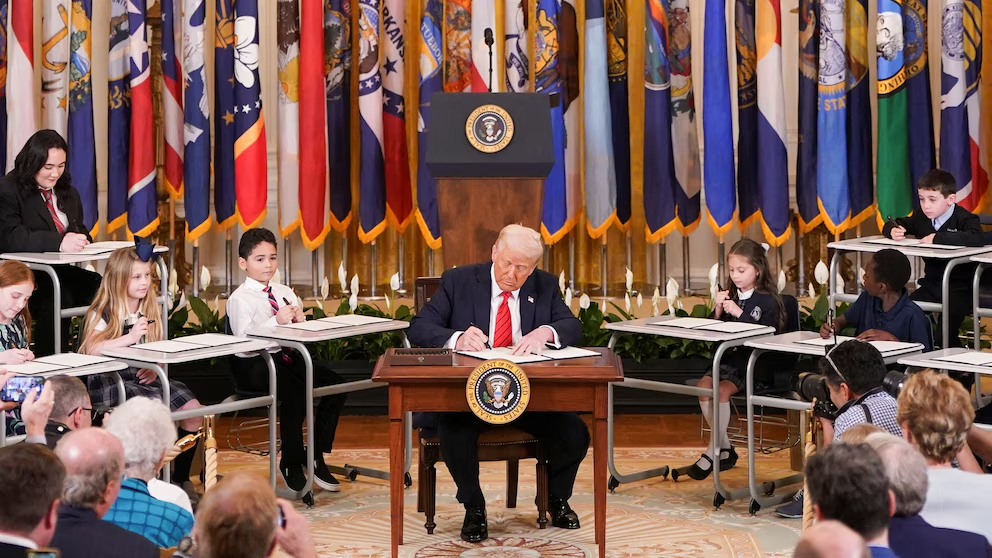
President Donald Trump signed an executive order on March 20 that eliminated the Department of Education. Republicans have been set on this decision for decades and we’re finally witnessing its coming to pass.
The Trump Administration took steps prior to the closure including firing workers. The staff has been cut in half and much of the work the department does is being scrutinized.
Trump, along with many other Republicans in the government, believes that education should be left up to the states, not the federal government.
In the U.S. education system, the states control the curriculum, teacher certification, and school funding. The federal government provides funding, implements national programs, and ensures equal access to education through policies and laws.
On the same day, Trump also signed into place the executive order, “Improving Education Outcomes by Empowering Parents, States, and Communities.” The newest order elaborates on the idea that closing the department would give children and their parents a chance to escape “a system that is failing them.”
What is the Department of Education?
The department is responsible for providing support to state and local education systems. It provides grants and loans to students who are eligible and provides assistance to institutions. Education equality was one of the department’s main focuses that prohibited discrimination on a variety of terms.
The department was founded in 1979 under President Jimmy Carter.
What does the closing mean for students?
The Department of Education has provided support to a variety of students including the disabled, those living in poverty, students with limited English proficiency, American Indian students, immigrant students, and helps all students in general with the possibility of student aid, funding, and grants.
The Education Department manages approximately $1.5 trillion in student loan debt for over 40 million borrowers. It also oversees the Pell Grant program, which provides aid to students below a certain income threshold, and administers the Free Application for Federal Student Aid ( FAFSA), which universities use to allocate financial aid.
Through the Office for Civil Rights, the Department of Education oversees issues to make sure that laws regarding LGBTQ+ students and students of color are protected fairly.
However, Trump also announced that he plans to exclude transgender students from the Title IX protections.
This affects students directly because policies on school bathrooms, locker rooms, and use of pronouns will be altered.
What does the closing mean for high schools and universities?
High Schools
A large sum of the Department of Education’s money that is given to K-12 schools goes through large federal programs.
Title I is a one of the programs that provides support for low-income students. The Individuals with Disabilities Education Act provides specialized services to individuals in need of assistance. This includes funding for smaller class sizes by adding additional teaching positions and funding for social workers and other non-teaching roles in schools.
Trump issued in his campaign that he would shift those functions to the states.
Public schools account for 90% of U.S. students and 95% of students with disabilities.
Students across the country benefit from programs run by the Department of Education.
Title I, which assists students with low-income finances, was eliminated. This means that states will be left up to decide where money goes. As proposed in Project 2025, Title I will be turned into block grants and handed over to individual states—without any sort of accountability or oversight.
As for the Individuals with Disabilities Act (IDEA), this program could be transferred to another agency. There are 7.5 million students who benefit from this program. By transferring IDEA to another agency, it is significantly less likely that students with disabilities receive the services and support they need and deserve.
“I have no idea what this is going to mean for our schools yet,” Intervention Specialist Pamela Shultz said. “I have talked to the School Psychologist about this and nobody seems to know yet how our school, and specifically Special Ed, will be impacted.”
Senior Evi Fromm plans to attend Bowling Green University in the fall to study early childhood education. “It worries me,” Fromm said. “Both of my parents have worked in education for a long time. It makes me worry because I know a lot of kids benefit from certain programs that the department provides. I think this could be a major step back for the education of future generations.”
Universities
The Department of Education plays a major role in higher education. It distributes some $120.8 billion in grant, work-study, and loan funds each year to help more than 9.9 million students and their families pay for college or career school.
The student’s who plan to advance their education fill out the Free Application for Federal Student Aid (FAFSA). The FAFSA helps students get money for their university studies.
How have people responded?
There have been mixed opinions about the closing of the Department of Education, but people are making sure that their opinions are being heard.
The day after Trump closed the department, Chloe Klenzle, of Arlington, Virginia, held a sign outside of the U.S. The Department of Education in Washington, D.C. which said, “Teachers supported me for 17 years. Now it’s time to support them.”
“At the White House right now,” Governor of Texas Greg Abbott said on social media. “Headed to see President @realDonaldTrump return control of education back to the states—where it belongs.”
 EagleView News